
Cormoran
Cornish giant who built St. Michael's Mount and raided cattle.
Cormoran is a giant from Cornish folklore, linked to St. Michael's Mount. Local stories say he built the island, sometimes with help from his wife Cormelian, and used it as a base to steal cattle from the mainland. He also appears in the English fairy tale "Jack the Giant Killer," where he is the first giant Jack kills, and in tales of "Tom the Tinkeard," where he is an old giant who no longer poses much danger.
The character comes from local Cornish traditions about St. Michael's Mount, though the name "Cormoran" is not found in early tales. It first appears in chapbook versions of "Jack the Giant Killer" printed in Newcastle-upon-Tyne and Nottingham, and is not Cornish in origin. The name may relate to Corineus, the legendary namesake of Cornwall, who is associated with St. Michael's Mount and defeats a giant named Gogmagog in Geoffrey of Monmouth's *Historia Regum Britanniae*—possibly a prototype for the Cormoran tradition.
According to folklore, Cormoran built St. Michael's Mount by carrying white granite from the mainland at low tide. In some versions, his wife Cormelian helped by carrying stones in her apron. One story says that when Cormoran fell asleep exhausted, his wife fetched greenstone from a nearer source. When she was halfway back, he woke, saw the different stones, and kicked her. The stones fell from her apron and formed Chapel Rock. From the Mount, Cormoran raided the countryside for cattle. He had six digits on each hand and foot. Folklorist Mary Williams reported being told that a skeleton over seven feet tall was found during an excavation at the Mount.
Cormoran is often linked with the giant of Trencrom. The two supposedly threw boulders back and forth for fun, explaining the many loose boulders in the area. In one version, the Trencrom giant threw a hammer that accidentally killed Cormelian; they buried her at Chapel Rock.
In "Jack the Giant Killer," early chapbooks first name the giant Cormoran. According to Joseph Jacobs' account, he is 18 feet tall and about 9 feet around the waist. He lives in a cave on St. Michael's Mount, using low tide to walk to the mainland. He regularly raids the countryside, feasting on people and carrying half a dozen oxen on his back. In Jacobs's version, Penzance councillors meet in winter to solve the problem, offering the giant's treasure as a reward. A farmer's boy named Jack takes on the task. Old
- field
- Folklore
- nationality
- Cornish
- known_for
- Creating St. Michael's Mount, raiding cattle, appearing in 'Jack the Giant Killer'
Lore & Background
Cormoran is attributed with constructing St. Michael's Mount, a tidal island off Cornwall's southern coast. According to folklore, he carried white granite from the mainland at low tide to build the island. In some versions, his wife Cormelian assisted by carrying stones in her apron; in one version, when she brought greenstone instead of granite, Cormoran kicked her, and the fallen stones formed Chapel Rock. From his post at the Mount, Cormoran raided the countryside for cattle and was distinguished by having six digits on each hand and foot. Folklorist Mary Williams reported being told that the skeleton of a man over seven feet tall had been found during an excavation at the Mount.
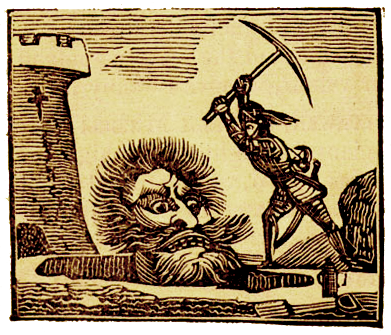
Cormoran is often associated with the giant of Trencrom in local folklore. The two are said to have thrown boulders back and forth as recreation, explaining the many loose boulders in the area. In one version, the Trencrom giant accidentally killed Cormelian with an enormous hammer, and they buried her at Chapel Rock. The giant also appears in 'Jack the Giant Killer', where he is 5.5 m (18 ft) tall, lives in a cave on St. Michael's Mount, and raids the mainland. Jack kills him by digging a trapping pit and striking him with a pickaxe. In 'Tom the Tinkeard', the giant grows old and frail, makes a failed raid, and is later fed by Tom's aunt Nancy.
Reader's Guide
Cormoran is a significant figure in Cornish folklore, embodying the region's tradition of giants associated with landscape features. His story explains the origin of St. Michael's Mount and nearby Chapel Rock, linking myth to geography. The name 'Cormoran' first appears in chapbook versions of 'Jack the Giant Killer' printed in Newcastle-upon-Tyne and Nottingham, and is not of Cornish origin; it may relate to Corineus, the legendary namesake of Cornwall, who defeated a giant named Gogmagog in Geoffrey of Monmouth's pseudohistory. This suggests the Cormoran tradition may have evolved from earlier literary prototypes. The giant's appearances in both 'Jack the Giant Killer' and 'Tom the Tinkeard' show his adaptability in folklore, from a fearsome antagonist to a diminished figure. The tale of his wife Cormelian and the formation of Chapel Rock adds a domestic and tragic dimension. The reported discovery of a tall skeleton at the Mount hints at possible historical roots. Cormoran's legacy endures as a key figure in Cornish identity and in the broader English fairy-tale tradition.
Did You Know?
- Cormoran is distinguished by having six digits on each hand and foot.
- The name 'Cormoran' first appears in chapbook versions of 'Jack the Giant Killer' printed in Newcastle-upon-Tyne and Nottingham, and is not of Cornish origin.
- In one version of the folklore, Cormoran's wife Cormelian formed Chapel Rock when stones fell from her apron after he kicked her.
- Folklorist Mary Williams reported being told that the skeleton of a man over seven feet tall had been found during an excavation at St. Michael's Mount.
Origins and the Question of His Name
Cormoran's identity as a figure of Cornish folklore is more layered than the name suggests. The giant himself is rooted in local traditions tied to St. Michael's Mount, a tidal island off Cornwall's southern coast. However, the specific name "Cormoran" does not appear in the earliest local traditions. It first surfaces in chapbook editions of the "Jack the Giant Killer" narrative printed in Newcastle-upon-Tyne and Nottingham, indicating the label is of English rather than Cornish provenance. Scholars have drawn a possible linguistic link between "Cormoran" and Corineus, the legendary figure credited as the namesake of Cornwall itself. Corineus is tied to St. Michael's Mount in Geoffrey of Monmouth's Historia Regum Britanniae, where he defeats a giant called Gogmagog. That older pseudohistorical account may well serve as a prototype from which the later Cormoran tradition evolved, suggesting the giant's story is a long, shifting thread woven through centuries of British legend rather than a single fixed tale.
Building the Island and Raiding the Coast
In the local Cornish tradition, Cormoran is credited with physically constructing St. Michael's Mount. The folklore describes him wading out at low tide and hauling white granite from the mainland to pile up the island. In several tellings, his wife Cormelian helps carry stones in her apron. One version adds a domestic drama: Cormoran dozes off from exhaustion, and his more resourceful wife switches to greener, more accessible stone from a closer source. When he wakes and sees the different rock, he kicks her, and the stones tumble from her apron to form Chapel Rock. From his perch on the Mount, Cormoran terrorized nearby communities by raiding their cattle. He was marked as otherworldly by having six digits on every hand and foot. Folklorist Mary Williams recorded a local claim that a skeleton of a man over seven feet tall had been unearthed during excavation work at the Mount. The giant is also linked to the figure known as the giant of Trencrom; the two supposedly hurled boulders at each other for sport, an act said to explain the scattered loose stones found across the surrounding landscape.
The Slaying in Jack the Giant Killer
The most widely known version of Cormoran's end comes from the English fairy tale "Jack the Giant Killer," in which early chapbook editions first apply his name. Joseph Jacobs's retelling paints the giant as a towering figure, roughly 18 feet tall and 9 feet around the waist, dwelling in a cave on the Mount and using ebb tide to reach the mainland. His raids are described in vivid, gruesome terms: he feasts on whatever humans he can catch and carries half a dozen oxen on his back while tying sheep and hogs around his waist like bundles of tallow-dips. In Jacobs's account, the councillors of Penzance convene in winter and offer the giant's treasure as a bounty. A farmer's boy named Jack accepts the challenge, swims to the island in the evening, and digs a 22-foot pit. The next morning he blows a horn; Cormoran charges out, threatens to roast Jack whole, and drops into the hidden hole. After a period of taunting, Jack finishes him with a pickaxe or mattock. In the Morvah variant, a rock marks the burial site, now called Giant's Grave, beneath which the giant's ghost is sometimes said to be heard.
An Alternative Fate in Tom the Tinkeard
Not every telling ends with Cormoran's death. In the drolls surrounding Tom the Tinkeard, a Cornish variant of the "Tom Hickathrift" tradition, the giant of St. Michael's Mount simply grows old and frail. William Bottrell recorded a version in which the aged giant, driven by hunger, makes one final foray to steal a bullock from an enchanter on the mainland. The enchanter strikes him into immobility just as the tide rushes in, forcing him to stand in the cold rising sea with the bull still hanging around his neck. He retreats to the Mount, defeated and still hungry. Tom, visiting the weakened giant, takes pity on him and arranges for the giant's aunt, Nancy of Gulval, to sell him her stores of eggs and butter. The arrangement feeds the old giant and simultaneously makes Nancy's family wealthy. This version strips away the heroic violence of the Jack narrative and instead presents Cormoran as a diminished, almost pitiable figure, a relic of a more violent age reduced to needing charity from a tinkeard and the goodwill of a local woman.
Gallery


Frequently Asked Questions
Who is Cormoran in British folklore?
Cormoran is a Cornish folklore giant most closely tied to St. Michael's Mount. Local tradition credits him with shaping the island and using it as a stronghold from which he raided cattle on the mainland.
What is Cormoran's role or special ability in the legends?
He is portrayed as a giant of immense physical strength, strong enough to build an entire island—occasionally with the aid of his wife Cormelian—and to carry off livestock from the coast. His size and power make him the archetypal threat to ordinary villagers in these Cornish tales.
In which stories does Cormoran appear?
He is the first giant slain by the hero in the chapbook tale 'Jack the Giant Killer.' He also shows up, in a diminished and elderly form, in the 'Tom the Tinkeard' stories, where he is no longer a serious danger.
How does Cormoran's story end?
In 'Jack the Giant Killer' he is killed by Jack during the hero's first encounter with the island's giants. In the 'Tom the Tinkeard' variant his fate is less dramatic; he is simply an aged giant who has lost most of his former menace.
Is Cormoran an ancient figure from early Cornish manuscripts?
Not exactly—the name 'Cormoran' does not surface in the earliest Cornish tales about the St. Michael's Mount giant. It first appears in later chapbook printings of 'Jack the Giant Killer,' even though the underlying island-builder and cattle-raider stories are older local traditions.
More in British folklore 1-24
Spotted an error? Know more?
This is a living reference — every entry is fact-audited, and reader corrections feed straight into our audit queue. Suggest an edit · See this site's audit record